Autopromocja / Autopromotion
Futures Trading: What Is It? A Complete Beginner's Guide
Author: AI Quant Team, AI SIGNALS COMPANY
The AI SIGNALS COMPANY Quant's Team AI specializes in systematic strategy design, microsecond-level order routing pipelines, and multi-regime risk management models. Our mission is to engineer high-asymmetry liquidity systems and translate complex institutional trading mechanics into transparent, data-driven frameworks.
Table of Contents
Every day, enormous sums move through markets most retail investors have never touched: futures markets. CME Group, the world's largest futures exchange, traded a record average of 28.1 million contracts per day in 2025. You've seen the headlines — "S&P 500 futures point higher," "Oil futures spike on supply fears" — but if you've ever asked yourself what futures trading actually is, you're not alone. It's one of the most searched, least understood corners of trading.
This guide breaks futures trading down from first principles: what a futures contract is, how the mechanics work with a real dollars-and-cents example, what it honestly costs to get started, and where AI-driven tools fit into the picture.
This is a complete beginner's guide: it starts from what a futures contract actually is and works through margin, leverage and the real costs of holding a position.
What Is Futures Trading?
Futures trading is the buying and selling of futures contracts — standardized, legally binding agreements to buy or sell an asset at a set price on a set future date. Traders use these contracts to speculate on price direction or to hedge existing risk, usually without ever taking delivery of the underlying asset.
Unlike buying a stock, where you own a piece of a company the moment you pay for it, a futures contract is a promise: an agreement between two parties to transact later, at a price locked in today. The "underlying asset" behind that promise can be almost anything with a liquid market:
- Commodities — crude oil, Brent crude, natural gas, gold, wheat, coffee
- Stock indices — the S&P 500, Nasdaq-100, Dow Jones
- Currencies — EUR/USD, GBP/USD, and other major pairs
- Interest rates and bonds — Treasury futures
- Digital assets — Bitcoin and Ethereum futures
Futures contracts trade on regulated exchanges — CME Group and ICE (Intercontinental Exchange) are two of the largest in the world — which guarantee every trade and remove counterparty risk through a clearinghouse. In the United States, the futures markets themselves are overseen by a federal regulator, the Commodity Futures Trading Commission (CFTC).
How Futures Contracts Actually Work
A few mechanics make futures fundamentally different from buying a stock outright.
Contract Specifications
Every futures contract has a standardized size (one E-mini S&P 500 contract represents $50 × the index value), a tick size (the minimum price movement and its dollar value), and an expiration date. You don't negotiate these terms — the exchange sets them, which is what makes the contract liquid and tradable. Most financial futures follow a quarterly expiration cycle, with month codes you'll see in every ticker: H (March), M (June), U (September), and Z (December) — so "ESZ6" is the E-mini S&P 500 expiring in December 2026.
Margin: Trading on a Deposit
You don't pay the full value of the underlying asset to open a futures position. Instead, you post a fraction of that value — called margin — as a good-faith deposit. This is what creates leverage: a relatively small amount of capital controls a much larger notional position. It's also what makes futures both powerful and dangerous — we'll put real numbers on it in the cost section below.
Mark-to-Market Daily Settlement
Unlike most stock positions, futures accounts are settled daily. Gains and losses are calculated and credited or debited to your account at the end of every trading session, not just when you close the position.
Cash Settlement vs. Physical Delivery
Some futures (like index futures) settle in cash — no one is delivering a bundle of stocks. Others (like crude oil or agricultural futures) can involve physical delivery, though the vast majority of retail traders close their positions well before expiration to avoid this entirely.
A Worked Example: One Micro E-mini Trade
Here's the whole mechanic in one trade, using the Micro E-mini S&P 500 (contract value: $5 × the index level):
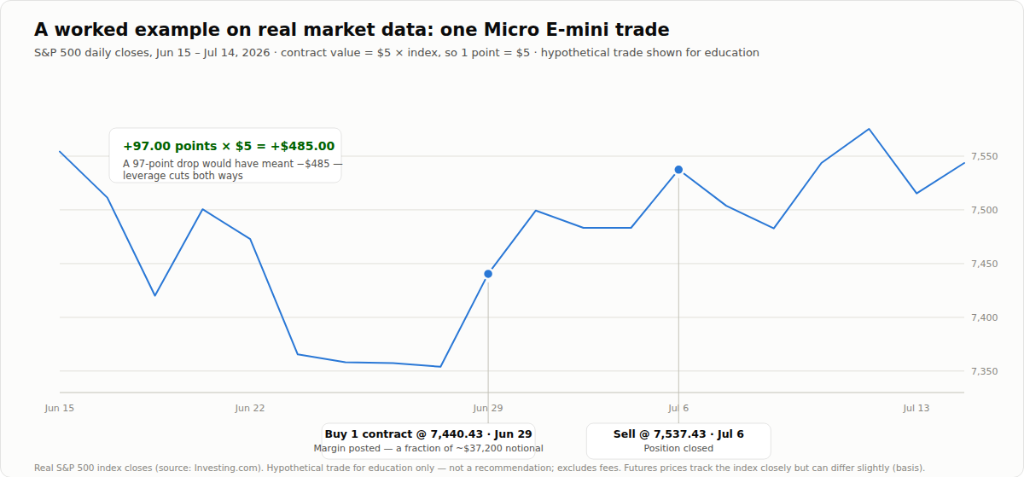
Real S&P 500 index closes (source: Investing.com). Hypothetical trade for education only — not a recommendation; excludes fees. Futures prices track the index closely but can differ slightly (basis).
In the chart above the index is at 7,440.43 on Jun 29. You buy one Micro E-mini contract — controlling roughly $37,200 of notional exposure (7,440 × $5) while posting only a margin deposit, not the full amount. The index rises 97 points to 7,537.43 by Jul 6 and you sell. Your gain is 97 points × $5 = $485, before fees. If the index had fallen 97 points instead, you'd have lost $485 — and because of daily mark-to-market settlement, that loss would have been debited from your account day by day as they occurred. Same math, both directions: that's leverage.
For scale, here's how the full-size and micro versions of the same contract compare:
| E-mini S&P 500 (ES) | Micro E-mini S&P 500 (MES) | |
|---|---|---|
| Contract multiplier | $50 × index | $5 × index |
| Notional value at 7,400 | $370,000 | $37,000 |
| Tick size | 0.25 points | 0.25 points |
| Value per tick | $12.50 | $1.25 |
| Exchange initial margin | Low-to-mid five figures (~$25,000, mid-2026) | Roughly one-tenth (~$2,500) |
(Margin requirements change with market volatility — always check current figures with your broker and the exchange before trading.)
Why Traders Use Futures
Futures markets exist for two fundamentally different groups of participants, and understanding both helps explain why the market behaves the way it does.
Hedgers use futures to reduce risk. An airline might buy oil futures to lock in fuel costs months in advance. A farmer might sell wheat futures to guarantee a price before harvest. For hedgers, futures are insurance, not speculation.
Speculators — which includes most retail and algorithmic traders — use futures to profit from anticipated price moves, without any intention of ever taking delivery of the underlying asset. Speculators provide the liquidity that makes the whole system function.
Beyond hedging and speculation, traders are drawn to futures for a few structural reasons:
- Capital efficiency. Margin requirements mean you can gain exposure to a large notional position with a fraction of the capital a direct purchase would require.
- Nearly 24-hour markets. Major CME futures trade from Sunday 6 p.m. to Friday 5 p.m. U.S. Eastern time, with a one-hour daily maintenance pause — compared with a stock exchange's fixed session.
- Deep liquidity. Index and commodity futures are among the most liquid instruments in the world, which generally means tighter spreads and more reliable execution.
- Diversification. Futures give access to asset classes — commodities, currencies, interest rates — that are harder to trade directly in a typical brokerage account.
Futures vs. Stocks vs. Options
Beginners usually arrive at futures after some exposure to stocks or options, so here's how the three actually differ:
| Stocks | Options | Futures | |
|---|---|---|---|
| What you hold | Ownership in a company | The right, not obligation, to buy/sell | A binding obligation for both sides |
| Leverage | Limited (typically up to 2:1 on margin) | Built into the premium | High — margin is a small fraction of notional |
| Expiration | None — hold indefinitely | Yes | Yes |
| Settlement | On sale of shares | At exercise or expiry | Daily mark-to-market |
| Trading hours | Exchange session (plus limited extended hours) | Exchange session | Nearly 24 hours, five days a week |
The FAQ below covers the futures-vs-options distinction in one sentence if that's all you need.
The Risks: Leverage Cuts Both Ways
Everything that makes futures attractive also makes them risky, and it's worth being direct about this rather than glossing over it.
Because positions are leveraged, losses — like gains — are magnified relative to the capital you've put up. A price move that would be a minor fluctuation for a stockholder can trigger a margin call for a futures trader: a demand from your broker to deposit additional funds immediately, or have your position liquidated. Markets can also gap sharply on overnight news, and daily mark-to-market settlement means losses are realized in real time, not just on paper.
The CFTC's own education materials make the same point bluntly: futures are a leveraged product where you can lose more than your initial deposit. This is precisely why futures are generally not recommended as a starting point for someone with no trading experience at all — the mechanics reward preparation and punish improvisation.
How Much Money Do You Actually Need to Start Trading Futures?
This is one of the most common questions beginners ask, and the honest answer is: it depends on the contract, the broker, and — critically — which kind of "margin" you're looking at.
Broker Day-Trading Margin vs. Exchange Margin
The confusion around cost almost always comes from two different numbers both being called "margin." Exchange initial margin is what the exchange requires to hold a position (including overnight) — for a full-size E-mini S&P 500 contract this sits in the low-to-mid five figures (on the order of $25,000 as of mid-2026), and for the Micro E-mini roughly one-tenth of that (about $2,500). Broker day-trading margin is a lower intraday-only requirement some brokers offer — sometimes just tens of dollars per Micro contract, or a few hundred for the full-size E-mini, valid only if you close the position before the session ends. When an ad promises "trade the S&P 500 with $50," it's quoting the second number, not the first. Both numbers change with market volatility, so always verify current requirements with your broker and the exchange — Charles Schwab's futures primer has a good plain-English breakdown of how the two interact.
Can You Trade Futures With $100?
Realistically, no. Even at brokers advertising rock-bottom intraday margins, $100 leaves no buffer for normal price fluctuation — a move of a few points against a Micro E-mini position would wipe the account or trigger an immediate liquidation. Micro contracts have genuinely lowered the entry point compared with a decade ago, but most brokers recommend a minimum balance well above $100 simply to survive ordinary volatility.
Is $5,000 Enough to Trade Futures?
For many traders, yes — with the right approach. $5,000 is a reasonable starting point for trading Micro contracts with disciplined position sizing and strict risk limits (many experienced traders risk only 1–2% of their account on a single trade). It is not enough capital to trade multiple full-size contracts or to absorb repeated losses without a clear risk management plan. The practical takeaway: position size and risk management matter more than the size of your account. A well-managed $5,000 account will outlast a poorly-managed $50,000 one.
One U.S.-specific footnote worth knowing: many futures contracts fall under Section 1256 of the tax code, which taxes gains on a blended 60/40 long-term/short-term basis regardless of holding period — a detail worth raising with a tax professional before you trade seriously.
Where AI Fits Into Modern Futures Trading
Futures markets generate an enormous amount of fast-moving data — price, volume, order flow, macro releases, cross-asset correlations — more than any individual can process by hand in real time. This is exactly the kind of environment where AI-driven analysis has found genuine traction: systematically monitoring multiple futures markets, flagging conditions that match predefined criteria, and helping traders act on a consistent process rather than in-the-moment emotion. We've written a full, honest assessment of what AI can and can't do in Is AI Good at Trading?, and a deeper look at the systematic side in Introduction to Quantitative AI Trading Strategies.
At ase-bot.live, this is the problem we focus on — using AI-driven signals to help traders monitor futures markets systematically. AI doesn't remove the risks described above, and no signal service can guarantee outcomes; it's a tool for process and consistency, not a shortcut around risk management.
Getting Started: A Simple Path for Beginners
- Learn the fundamentals first. Understand contract specs, margin, and settlement before risking real capital.
- Paper trade. Practice with a simulated account until you can execute your strategy without hesitation — our guide to stock and trading simulators covers the options.
- Start small with Micro contracts. They let you experience real market conditions with a fraction of the capital and risk of full-size contracts.
- Set hard risk limits before you trade — not after. Decide your maximum loss per trade in advance.
- Scale gradually as your process proves consistent, not as a reaction to a lucky win.
For a closer look at where to actually place your first trade, see our comparisons of the top futures trading platforms for beginners and AI-powered futures trading tools.
Frequently Asked Questions
What is futures trading in simple terms?
It's buying or selling a standardized contract that locks in a price today for a transaction that settles later, typically used to speculate on price direction or hedge existing risk.
Can you trade futures with $100?
Not realistically. Even at brokers with very low intraday margins, $100 leaves no buffer for normal price movement; most brokers recommend meaningfully more to withstand ordinary volatility.
Is $5,000 enough to trade futures?
For Micro contracts with disciplined risk management, yes, it can be a reasonable starting point. It is not enough to trade full-size contracts or to skip risk management.
What's the difference between futures and options?
A futures contract obligates both parties to transact at the agreed price on the settlement date. An option gives the buyer the right, but not the obligation, to transact — the buyer can simply let it expire.
What hours do futures trade?
Major CME futures trade nearly around the clock on weekdays — from Sunday 6 p.m. to Friday 5 p.m. U.S. Eastern time, with a one-hour daily maintenance pause — which is one of the practical advantages over stock-market hours.
Is futures trading risky?
Yes. Leverage magnifies both gains and losses, daily settlement means losses are realized quickly, and it's possible to lose more than your initial deposit. It's not recommended without a clear risk management plan.
Institutional Access & Internal Execution
While our proprietary machine learning models and order-routing signals are deployed primarily for internal portfolio management and proprietary funds, we offer high-fidelity execution data feed subscriptions exclusively for medium to large-scale enterprises. Subscriptions for institutional API access start at $10,000 USD per month. Qualified firms can contact our desks or use the platform interface to review our real-time telemetry log performance before integration.
Note from the Quant's Team: This guide was prepared by the AI from our quant team. At AI SIGNALS COMPANY, we believe that understanding the structural design of financial products is the first step toward building consistent, algorithmic trading models.
Investing in financial markets, particularly in high-growth and volatile sectors such as Artificial Intelligence, involves a high degree of risk. You may lose some or all of your invested capital. Past performance, whether actual or simulated, is not indicative of future results. The financial data, market valuations, and macroeconomic trends discussed herein are based on sources believed to be reliable as of mid-2026, but no warranty, express or implied, is made regarding their accuracy, completeness, or timeliness.
The author and AI Signals Company are not registered financial advisors. Any trading decisions made based on the information provided or the use of our software tools are made entirely at your own risk. Readers are strongly encouraged to conduct their own independent research and consult with a licensed financial advisor or broker before making any investment decisions.
Inwestowanie na rynkach finansowych, w szczególności w wysoce zmiennych sektorach technologicznych takich jak sztuczna inteligencja, wiąże się z wysokim ryzykiem, włączając w to ryzyko utraty części lub całości zainwestowanego kapitału. Historyczne wyniki osiągane przez spółki lub portfele symulowane nie stanowią żadnej gwarancji osiągnięcia podobnych rezultatów w przyszłości. Dane finansowe, wyceny rynkowe oraz trendy makroekonomiczne omówione w tekście opierają się na źródłach uznanych za wiarygodne na stan z połowy 2026 roku, jednak nie gwarantuje się ich absolutnej dokładności ani kompletności.
Autor artykułu oraz podmiot AI Signals Company nie są licencjonowanymi doradcami inwestycyjnymi. Wszelkie decyzje inwestycyjne podjęte na podstawie treści tego materiału lub przy użyciu opisywanych narzędzi analitycznych użytkownik podejmuje wyłącznie na własne ryzyko i odpowiedzialność. Zaleca się przeprowadzenie własnej, niezależnej analizy oraz konsultację z licencjonowanym doradcą finansowym przed zaangażowaniem kapitału.